
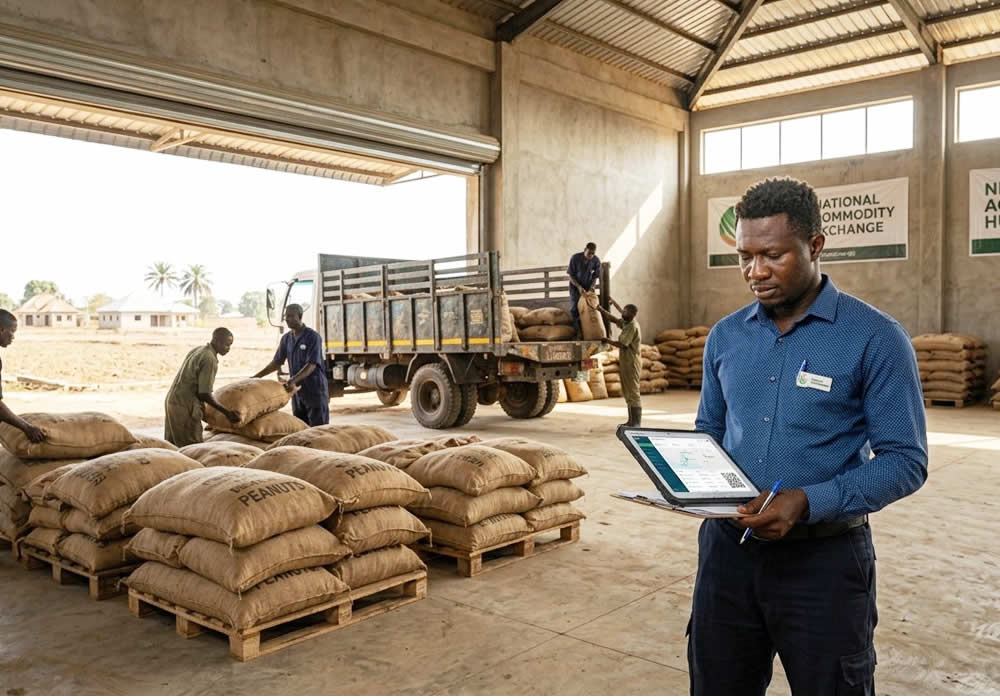
Agricultural commodities rarely move directly from individual farms to international buyers. Between production and the final market, there is an important stage known as commodity aggregation.
Aggregation involves collecting agricultural products from multiple farmers or small-scale suppliers and consolidating them into larger, organised quantities. This process plays an important role in connecting smallholder producers with processors, exporters, manufacturers and other bulk buyers.
Across West Africa, commodity aggregation is particularly important for products such as cocoa, cashew, sesame, coffee, shea products, grains and other agricultural commodities.
Understanding how aggregation works helps explain how agricultural products move from dispersed farms into organised supply chains.
What Is Commodity Aggregation?
Commodity aggregation is the process of collecting products from multiple producers or suppliers and combining them into larger quantities for storage, processing, transportation or sale.
A simplified supply chain may look like this:
Farmer → Local Collector → Aggregator → Warehouse → Processor/Exporter → Buyer
The exact structure varies depending on the commodity, location and market.
For example, a cocoa farmer may produce a relatively small quantity of cocoa during a harvesting period. An aggregator can purchase cocoa from many farmers and combine the quantities into a larger batch that can be transported and supplied to a warehouse, processor or exporter.
Why Is Aggregation Necessary?
Agricultural production is often fragmented.
Thousands of smallholder farmers may produce relatively small quantities across different communities. Most international buyers and large processors, however, require significantly larger and more consistent volumes.
Aggregation helps bridge this gap.
Instead of a buyer having to purchase small quantities individually from hundreds or thousands of farmers, an aggregator can consolidate supply and provide a larger quantity through a more organised process.
This can make the supply chain more efficient for both producers and buyers.
1. Collection at the Farm Gate
The aggregation process often begins at or near the farm gate.
Farmers harvest their commodities and prepare them according to the relevant handling requirements. Local buyers, collectors or aggregation teams may then purchase or collect the produce.
At this stage, basic information may be recorded, such as:
- Farmer or supplier identification
- Location
- Commodity type
- Quantity
- Date of collection
- Purchase price
- Batch or lot information
- Quality observations
Accurate records at the farm-gate stage can become important later when the commodity needs to be traced or its quality investigated.
2. Initial Quality Assessment
Quality control should begin as early as possible in the supply chain.
Depending on the commodity, collectors or aggregators may inspect the produce for factors such as:
- Moisture
- Foreign matter
- Physical damage
- Mould
- Pest damage
- Ripeness
- Cleanliness
- Size and grade
- Other buyer-specific requirements
For cocoa, for example, quality assessment may include checking fermentation, moisture, bean defects and general condition.
Early inspection helps prevent unsuitable material from being mixed into larger quantities.
3. Consolidating Supply
Once commodities have been collected from different farmers, the aggregator consolidates them into larger quantities.
This is the central function of aggregation.
Consider a simple example:
A buyer requires 50 tonnes of cocoa.
Individual farmers may only supply a few hundred kilograms or a few tonnes each. An aggregator can collect cocoa from many suppliers and gradually build the required volume.
This creates economies of scale in storage, transportation and commercial transactions.
4. Sorting and Grading
Before commodities are moved into long-term storage or supplied to a buyer, they may need to be sorted or graded.
The exact process depends on the commodity.
Sorting can help separate products according to characteristics such as:
- Quality
- Size
- Moisture
- Colour
- Variety
- Grade
- Physical condition
Keeping different grades or qualities appropriately separated can help maintain consistency and prevent higher-quality products from being mixed unnecessarily with lower-quality material.
5. Weighing and Documentation
Accurate weighing is an important part of commodity aggregation.
Each delivery should ideally be weighed using suitable equipment, with the relevant quantity recorded.
Documentation may include:
- Supplier details
- Gross weight
- Net weight
- Date received
- Quality information
- Batch number
- Purchase information
- Storage location
These records help the aggregator maintain control over inventory and provide information to buyers when required.
6. Storage at the Aggregation Centre
After collection and initial quality checks, commodities may be moved to an aggregation centre or warehouse.
Storage conditions depend heavily on the type of commodity.
The storage facility should be appropriate for protecting the product from factors such as:
- Moisture
- Excessive heat
- Pests
- Contamination
- Poor ventilation
- Physical damage
For commodities such as cocoa, proper storage is particularly important because poorly controlled conditions can affect quality and increase the risk of mould or deterioration.
7. Batch Identification and Traceability
Aggregation can make traceability more challenging because products from multiple suppliers are brought together.
For this reason, proper batch identification is important.
An aggregator may assign identification numbers to different deliveries or consolidated lots. These records can help establish:
- Which suppliers contributed to a batch
- Where the commodity was collected
- When it was received
- What quality checks were conducted
- Where it was stored
- When it was dispatched
- Which buyer received it
The level of traceability required will depend on the commodity, buyer and destination market.
8. Inventory Management
Once commodities enter a warehouse, effective inventory management becomes essential.
The aggregator needs to know how much stock is available and where it is located.
Good inventory records can help answer questions such as:
- How much stock is currently available?
- Which batches are in storage?
- Which suppliers contributed to each batch?
- What quantity has already been allocated to buyers?
- Which stock is ready for dispatch?
- When was each batch received?
Accurate inventory information helps prevent errors and improves planning.
9. Preparing for Bulk Buyers
One of the major advantages of aggregation is that it allows smaller quantities from different producers to be consolidated into commercially significant volumes.
Once sufficient quantities have been collected and quality requirements have been met, the commodity can be prepared for a bulk buyer.
Depending on the transaction, this may involve:
- Final quality inspection
- Re-weighing
- Packaging or bagging
- Batch confirmation
- Documentation
- Loading
- Transportation
- Final buyer inspection
The commodity then moves from the aggregation stage towards processing, export or another destination market.
10. The Role of Aggregators in the Agricultural Supply Chain
Aggregators perform more than simply buying and reselling agricultural products.
A well-organised aggregator can provide several important supply-chain functions, including:
Connecting Farmers With Markets
Aggregators provide farmers with access to buyers that they may not be able to reach individually.
Consolidating Volumes
They combine small quantities into commercially viable volumes.
Supporting Quality Control
They can inspect, sort and grade commodities before they enter larger supply chains.
Providing Storage
Aggregation facilities can temporarily store commodities while larger quantities are being assembled.
Improving Logistics
Consolidating commodities can make transportation more efficient.
Supporting Market Information
Aggregators can provide farmers with information about quality requirements, demand and market conditions.
Challenges in Commodity Aggregation
Although aggregation creates significant opportunities, it also comes with challenges.
Inconsistent Quality
Products from different farms may have different quality characteristics. Without proper sorting and quality controls, inconsistent commodities can be mixed together.
Limited Storage Capacity
Insufficient or unsuitable storage can lead to deterioration, especially for commodities that are sensitive to moisture or pests.
Price Fluctuations
Agricultural commodity prices can change during the purchasing and selling period, creating financial risks for aggregators.
Transportation Challenges
Poor roads, long distances and limited transport availability can increase the cost and time required to move commodities.
Record-Keeping
Managing information from many farmers and suppliers can become difficult when businesses rely heavily on manual records.
Traceability
As more suppliers contribute to larger batches, maintaining accurate records of origin and movement becomes increasingly important.
Technology and the Future of Commodity Aggregation
Technology is increasingly being used to improve agricultural aggregation.
Digital systems can help businesses manage:
- Farmer registration
- Supplier records
- Digital weighing
- Quality inspection
- Batch identification
- Warehouse inventory
- Purchase transactions
- Logistics
- Buyer orders
- Traceability
Even relatively simple digital record systems can provide significant improvements over fragmented paper-based records.
For larger operations, specialised agricultural supply-chain software can provide greater visibility across multiple collection centres and warehouses.
From Smallholder Production to Global Markets
Commodity aggregation provides an important link between smallholder agricultural production and larger domestic and international markets.
A farmer may produce a relatively small quantity, but when the production of hundreds or thousands of farmers is properly collected, assessed, documented and consolidated, it can become a commercially significant supply.
This is one of the reasons aggregation remains an important part of agricultural supply chains across West Africa.
Conclusion
From the farm gate to the warehouse, commodity aggregation involves much more than simply collecting agricultural products.
It requires collection, quality assessment, weighing, sorting, consolidation, storage, documentation and inventory management.
When these processes are properly managed, aggregation can help connect smallholder farmers with larger markets while providing buyers with more organised and consistent supply.
For businesses operating in West Africa’s agro-commodity sector, building efficient aggregation systems can contribute to better quality control, stronger traceability, improved logistics and more reliable relationships with buyers.
Ultimately, the journey from farm gate to warehouse is a critical part of transforming dispersed agricultural production into a dependable commercial supply.